
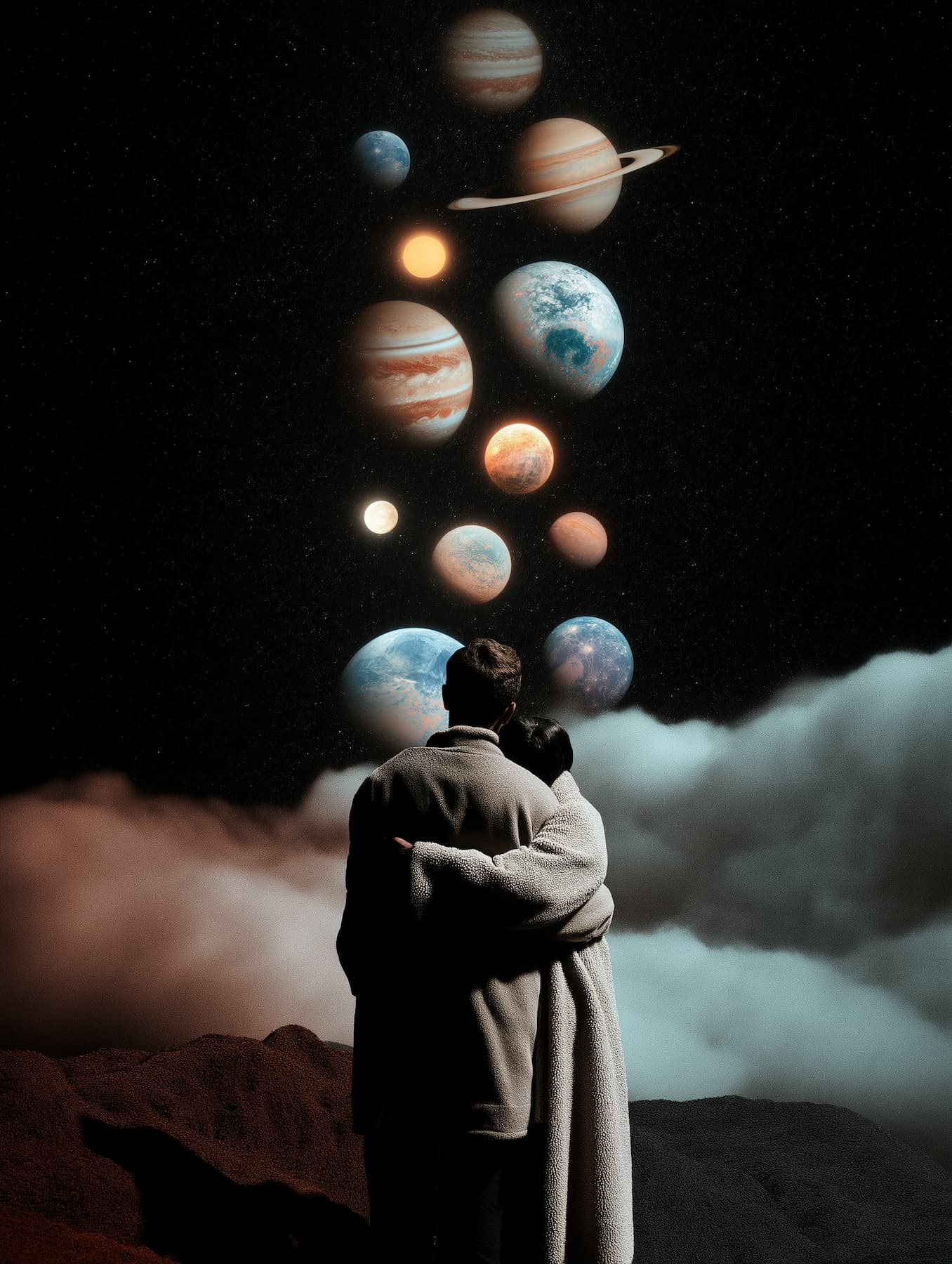
For centuries, religion shaped humanity’s understanding of the universe. Many ancient cultures viewed Earth as the spiritual center of existence, while religious traditions often described humanity as uniquely connected to divine creation. Today, however, modern space exploration is forcing both religious institutions and individual believers to reconsider some of their oldest assumptions.
The growing possibility of life beyond Earth is no longer treated purely as science fiction. Advances in astronomy, astrophysics, and planetary research have made discussions about extraterrestrial life increasingly serious. Thousands of exoplanets have already been discovered, many located in so-called habitable zones where conditions may support life. Scientists now openly debate the likelihood of microbial organisms – and potentially intelligent civilizations – existing elsewhere in the universe.
This scientific shift is quietly influencing modern religious thought in ways that would have seemed unimaginable only a generation ago.
Religion in an Expanding Universe
Historically, many religions developed during periods when humanity had a very limited understanding of the cosmos. Ancient civilizations looked at the stars with wonder, but the universe itself remained mysterious and unreachable. Spiritual systems naturally focused on Earth, human morality, and the relationship between people and the divine.
Modern astronomy changed this perspective dramatically. Humanity now understands that Earth is only one planet orbiting one ordinary star inside a galaxy containing billions of stars. Beyond that, there are billions of additional galaxies stretching across the observable universe.
For some believers, this vastness strengthens spirituality. The scale of the cosmos can inspire awe and reinforce the idea of divine creation. For others, however, it raises difficult theological questions. If intelligent life exists elsewhere, what does that mean for humanity’s special role in religious traditions? Would alien civilizations have their own spiritual systems? Could concepts such as salvation, prophecy, or divine revelation apply beyond Earth?
These questions are becoming more common as space science advances.
Younger Generations Are More Open to Cosmic Spirituality
One of the biggest cultural shifts is happening among younger generations. Many younger people no longer see science and spirituality as direct opposites. Instead, they often combine scientific curiosity with personal spiritual exploration.
This has contributed to the rise of what some sociologists describe as “cosmic spirituality” – a worldview that blends fascination with the universe, existential reflection, environmental awareness, and non-traditional forms of spirituality. Space imagery, astronomy content, and discussions about extraterrestrial intelligence increasingly appear alongside conversations about consciousness, meaning, and humanity’s place in existence.
Unlike previous generations, younger audiences often approach religion less through rigid doctrine and more through philosophical curiosity. Questions about alien life therefore become spiritual as well as scientific.
The possibility that humanity may not be alone challenges deeply rooted assumptions about identity, uniqueness, and purpose. For some people, this creates anxiety. For others, it expands their sense of spiritual imagination.
Religious Institutions Are Slowly Responding
Many major religious institutions have become more cautious and open-minded regarding extraterrestrial life than people often assume.
Some Catholic theologians, for example, have publicly discussed the possibility that alien life could exist without contradicting Christian belief. Certain Islamic scholars have also argued that the existence of other life forms would not necessarily conflict with Islamic teachings, particularly because the universe itself is often described in expansive and mysterious terms.
At the same time, not all religious communities respond comfortably to these discussions. More literal interpretations of sacred texts sometimes struggle with the idea that humanity may not occupy a completely unique position in creation. This tension is especially visible online, where debates about science, religion, and extraterrestrial intelligence often become emotionally charged.
The growing popularity of space exploration forces religious communities into unfamiliar territory. Questions that once belonged exclusively to science fiction are slowly becoming part of mainstream cultural discussion.
Space Exploration Is Changing Human Perspective
Space missions themselves are also influencing spirituality in indirect ways.
Astronauts frequently describe profound psychological experiences while observing Earth from space. Many report feelings of interconnectedness, humility, or spiritual reflection after seeing the planet from orbit. This phenomenon is sometimes called the “overview effect,” where viewing Earth as a small and fragile world changes a person’s perception of humanity.
Images captured by telescopes and space probes have produced similar effects on the public. Photographs of distant galaxies, black holes, and planetary systems encourage people to think beyond national, cultural, and even religious boundaries.
In this sense, space exploration may be creating a more universal form of spiritual thinking. Rather than focusing only on specific religious identities, many people are becoming more interested in humanity’s shared existence within a vast and largely unknown universe.
The Rise of New Spiritual Narratives
Modern entertainment and digital culture are also contributing to this transformation. Films, television series, video games, and online communities increasingly mix cosmic themes with spiritual questions. Stories about advanced civilizations, artificial intelligence, interstellar travel, and alien contact often explore morality, consciousness, and the meaning of existence in ways that resemble religious discussion.
As a result, spiritual imagination itself is evolving. Traditional religious concepts are being reinterpreted through the lens of space exploration and technological progress.
Some people now speak about humanity’s future among the stars almost in spiritual terms. Colonizing other planets, preserving civilization beyond Earth, or encountering other intelligent life forms are sometimes framed as events that could permanently transform human consciousness.
This does not necessarily mean traditional religion is disappearing. Instead, religion is entering dialogue with a rapidly expanding scientific worldview.
Fear, Meaning, and the Unknown
At its core, the discussion about extraterrestrial life is not only about science. It is also about meaning.
Human beings have always used religion to answer fundamental questions:
- Why are we here?
- Are we alone?
- What is our purpose?
- What exists beyond our world?
Space exploration does not eliminate these questions. In many ways, it intensifies them.
The possibility of alien life forces humanity to confront uncertainty on a much larger scale. It challenges long-standing assumptions about identity, superiority, and cosmic importance. At the same time, it may also encourage greater humility and curiosity.
For some believers, the universe becomes more spiritually powerful when viewed as vast and potentially filled with life. For others, these ideas create tension with older theological structures.
Either way, space exploration is already reshaping modern spirituality. The more humanity learns about the universe, the harder it becomes to separate scientific discovery from existential and religious reflection.